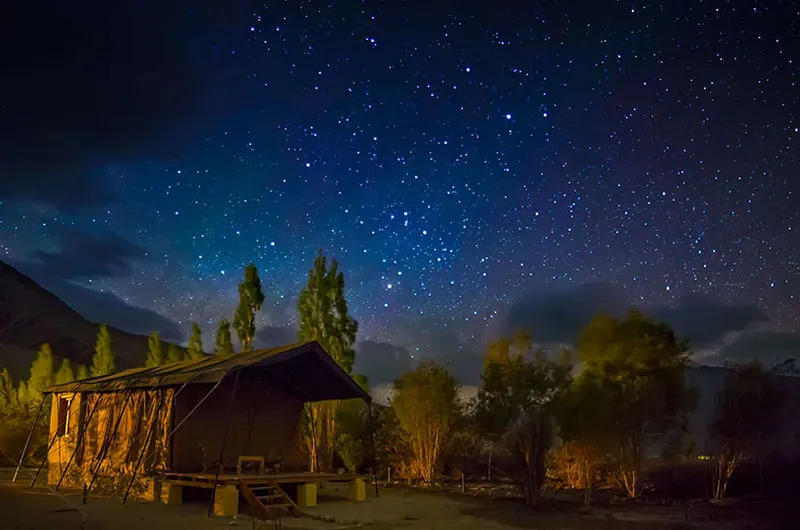
Nubra Valley Night Sky Experience
June 17, 2026
There are places in India where the sky at night stops being background and becomes the reason you came. Nubra Valley is one of them. The elevation, around 3,000 metres on the valley floor, the distance from any city with meaningful light pollution, and the specific high-altitude atmosphere of the Karakoram region combine to produce a night sky that most people in India have never experienced and don’t know is accessible without a telescope or a special expedition. The Nubra Valley Night Sky Experience is the specific thing that brings photographers, astronomers, and first-time Ladakh visitors back to the same valley the following year.
Why Nubra Specifically
The Ladakh plateau as a whole is good for stargazing. Nubra is better than most of it. The valley floor sits lower than the surrounding passes, the Khardung La at 5,359 metres drops into the valley at around 3,000 metres, which means the temperature is more manageable at night than at the high-altitude camping sites. The sand dunes near Hunder sit in an open stretch of valley with the Karakoram range on the horizon and no artificial light between the campfire and the summit of the mountains above. The Nubra Valley Night Sky Experience at the dunes specifically is the combination of desert foreground and mountain silhouette that the night photography community has been quietly targeting for years.
The Milky Way core is visible from Nubra between March and October with the naked eye. Not a faint suggestion of the galactic band, the full structure, the dust lanes, the core glow, the version that the textbook photographs use. Most people see this for the first time in Nubra and describe the experience in terms that sound like exaggeration until you’ve been there yourself.
What Tourists Should Expect from Nubra Valley
The Nubra Valley Night Sky Experience requires some preparation from tourists who haven’t done high-altitude stargazing before. The cold is the first variable. Even in summer, June and July when the days are warm, the Nubra Valley night drops to single digits and sometimes below. A proper down layer, not a fleece, is the specific preparation that makes the difference between a two-hour stargazing session and a twenty-minute one.
What tourists should expect from Nubra Valley in terms of the sky timeline: the Milky Way rises over the eastern horizon and arcs across the valley during the prime viewing window, which runs from roughly 10 pm to 2 am during the summer months. The best viewing happens on the new moon nights when the moonlight doesn’t wash out the fainter stars. Check the lunar calendar before booking the specific nights in Nubra.
The stars here are not just more numerous than what the plains sky shows, they are categorically different. The Andromeda galaxy visible with the naked eye. The Pleiades sharp and distinct rather than a blur. The planets, when Jupiter or Saturn is in the sky, visible with surface detail through even a basic pair of binoculars.
Best Time to Visit Nubra Valley
March to July is when Ladakh opens properly and the Nubra Valley Night Sky Experience is at its most accessible. The Khardung La, the pass connecting Leh to Nubra, clears of snow in late April and the road stays reliable through to October. March and April give the cold-weather clarity that the atmosphere produces when the temperature drops, the sharpest skies of the year. May and June add the comfortable temperature window for extended outdoor viewing. July brings the monsoon periphery to Ladakh, not the full monsoon, but occasional cloud that can interrupt the sky on individual nights.
June is the specific month that combines the long days, the comfortable evenings, the clear sky frequency, and the apricot blossom timing in the Nubra orchards, the best overall window for the tourist whose trip includes the Night Sky Experience alongside the daytime valley activities.
What Tourists Should Expect from Nubra Valley Beyond the Sky
The Bactrian camels on the Hunder dunes at dawn. The Diskit Monastery before the day visitors arrive from Leh. The Nubra River running through the orchard-lined valley. The hot springs at Panamik. Samstanling Monastery with the monks going about their practice. The valley is the experience beyond the sky, the sky is what makes staying the extra night the obvious decision.
Lchang Nang, Nubra Valley
Lchang Nang in Teggar Village sits on the banks of the Nubra River with the Karakoram range directly above. The sand dunes are 2 to 3 kilometres away, the specific distance that makes the BBQ evening and the stargazing session a walk rather than a drive. The Nubra Valley Night Sky Experience from Lchang Nang is the version with the orchard in the foreground, the river audible from the sitting area, and the mountain silhouette defining the horizon above the Milky Way. What tourists should expect from Nubra Valley at Lchang Nang is the full experience, the sky, the valley, the heritage property, and the morning that follows.