What Regenerative Travel Actually Means — And How We Practice It at Lchang Nang
July 23, 2026
1. Every Hotel Claims to Be Green Now
You’ve seen the badges. “Eco-certified.” “Carbon-neutral.” “Green-friendly.” They appear on the booking page between the wifi speed and the cancellation policy, and most of us scroll past them without a second thought.
And honestly? Fair enough. A lot of it is noise.
But somewhere underneath the greenwashing, beneath the bamboo straws and the recycling bins that lead nowhere, there’s a more serious question worth asking. What does it actually mean to travel in a way that gives something back? Not just “doesn’t destroy”, but actively restores?
That’s the question regenerative travel is trying to answer. And it’s a harder question than it looks.
2. It’s Not About Doing Less Damage. It’s About Doing Actual Good.
Sustainable travel, at its best, means doing less harm. Don’t disturb the ecosystem. Don’t overwhelm the local economy. Don’t leave too much behind.
Regenerative travel asks something more ambitious: What if your visit left the place genuinely better than you found it?
Not just intact. Better.
That means local employment that builds real skills, not just seasonal work. Food systems that strengthen what farmers were already doing. Buildings that fit the landscape instead of fighting it. Cultural experiences that aren’t performances, they’re just life, and you’re invited to observe it honestly.
Regenerative travel in India is still a young idea. But a few places have been quietly living it for years, long before anyone had a name for it.
3. This Place Existed Long Before Anyone Called It a Retreat
Lchang Nang sits in the Nubra Valley of Ladakh, on land that belonged to the Kalon family long before the concept of “boutique retreat” existed anywhere in India.
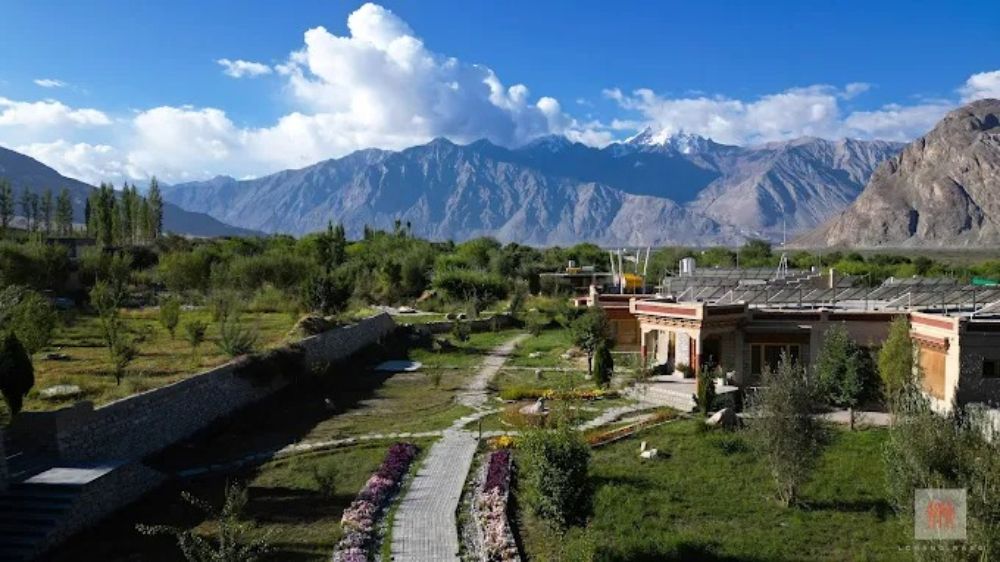
The family didn’t buy a plot and build something for tourists. They opened what was already theirs, grazing lands by the Siachen river, surrounded by poplar and willow and Siberian elm, and asked what a guest property could look like if it took the land’s existing rhythms seriously.
That sequence matters. The place didn’t start with a blueprint. It started with a relationship to the land.
That’s what makes regenerative travel in India so difficult to manufacture. You can’t design your way into it. You have to start from somewhere real.
4. Mud Walls. River Stone. No Concrete. Here’s Why That Matters.
The 17 cottages at Lchang Nang are built from mud, river stone, poplar, and local timber, the same materials Ladakhi families have used for centuries. Not as an aesthetic choice. As the only choice that makes sense here.
Concrete doesn’t breathe the way mud walls do. It doesn’t regulate temperature in a high-altitude desert environment. It doesn’t belong to the visual language of the valley. And it doesn’t involve local craftspeople who carry generations of knowledge about how to build in this particular landscape.
Solar panels power the retreat. Glacial meltwater, filtered and treated, supplies it. Waste is composted. Plastic is not a feature of the experience.
None of this is marketed aggressively. It’s just how the place is run.
5. The Menu Changes With the Valley. Not the Other Way Around.
The kitchen at Lchang Nang doesn’t try to be everything to everyone.
What grows here, grows seasonally. What the valley produces, barley, local vegetables, apricots in their short spectacular window, shows up on the table. Ladakhi recipes that have fed families in this region for generations appear alongside simpler preparations that let the produce speak without interference.
This is what slow travel looks like at the table. Not a menu engineered for tourist palates. Not ingredients airlifted from elsewhere. Just honest, seasonal, local food served in a place where it makes complete sense.
Eating this way recalibrates something. You stop thinking about what you’re missing and start noticing what’s actually here.
6. When the Guide Grew Up on This Path, the Walk Means Something Different
A lot of travel brands talk about “community involvement.” In practice, this sometimes means a folk dance performance between dinner and dessert.
Lchang Nang is owned by a family from Nubra. Staff are from the valley. The cultural music and dance experiences, the visits to Samstanling Monastery, the guided walks through working villages, these aren’t shows. They’re introductions.
When the person showing you around the village is from the village, the conversation changes entirely. When the family whose grazing land you’re staying on is still present in the daily life of the retreat, the experience is rooted in something real.
That’s the difference between tourism that extracts culture and regenerative travel in India that actually participates in it.
7. Forget the Brochure. Here’s What an Actual Day Looks Like
Start your Morning with yoga at a glacial lake, where the stillness is not manufactured. Breakfast from the farm table, what the valley grew, not what the supply chain delivered. A slow start, because that’s the right pace here.
Then in the Afternoon, go for a guided walk through the village. Not a tour. A walk, with someone who knows every family on the path and stops to speak with them. Or mountain biking into a landscape you didn’t know could exist at this altitude.
End your day with dinner under the elms. Or a BBQ by the sand dunes with Bactrian camels grazing somewhere nearby in the dusk. Stargazing at an altitude where the sky does something genuinely unreasonable.
Every single one of these moments supports a local economy, minimises environmental disruption, and creates memory through genuine connection, not manufactured experience. This is eco-conscious travel that you feel rather than read about.
8. You Can’t Understand a Place From a Moving Car
The one thing regenerative travel in India requires, more than anything else, is time.
You can’t regenerate your relationship with a place in 48 hours. You can’t understand a landscape from a car window. You can’t appreciate a food culture from a buffet line.
Lchang Nang offers itineraries up to 7 days, not because there’s a long checklist of activities, but because the valley reveals itself slowly. The Nubra River looks different at different times of day. The monastery makes more sense the second time you visit. The farm table means something different after you’ve walked past the fields it came from.
Slow travel isn’t a luxury add-on. It’s the actual point.
9. Nubra Valley Has Been Doing This Quietly for Years. Now You Know Where to Go
If you’ve read this far and you’re nodding along, Lchang Nang Retreat in Nubra Valley Ladakh, is one of the most honest expressions of regenerative travel in India you’ll find anywhere. No greenwashing. No eco-theatre. Just a family’s land, opened thoughtfully, run on solar power and glacial water, staffed by local hands, fed by the valley’s own seasons, sitting quietly by a river that has been here far longer than any hotel. National Geographic, Condé Nast Traveller, and Architectural Digest have all noticed. But more importantly, guests who come once tend to come back.