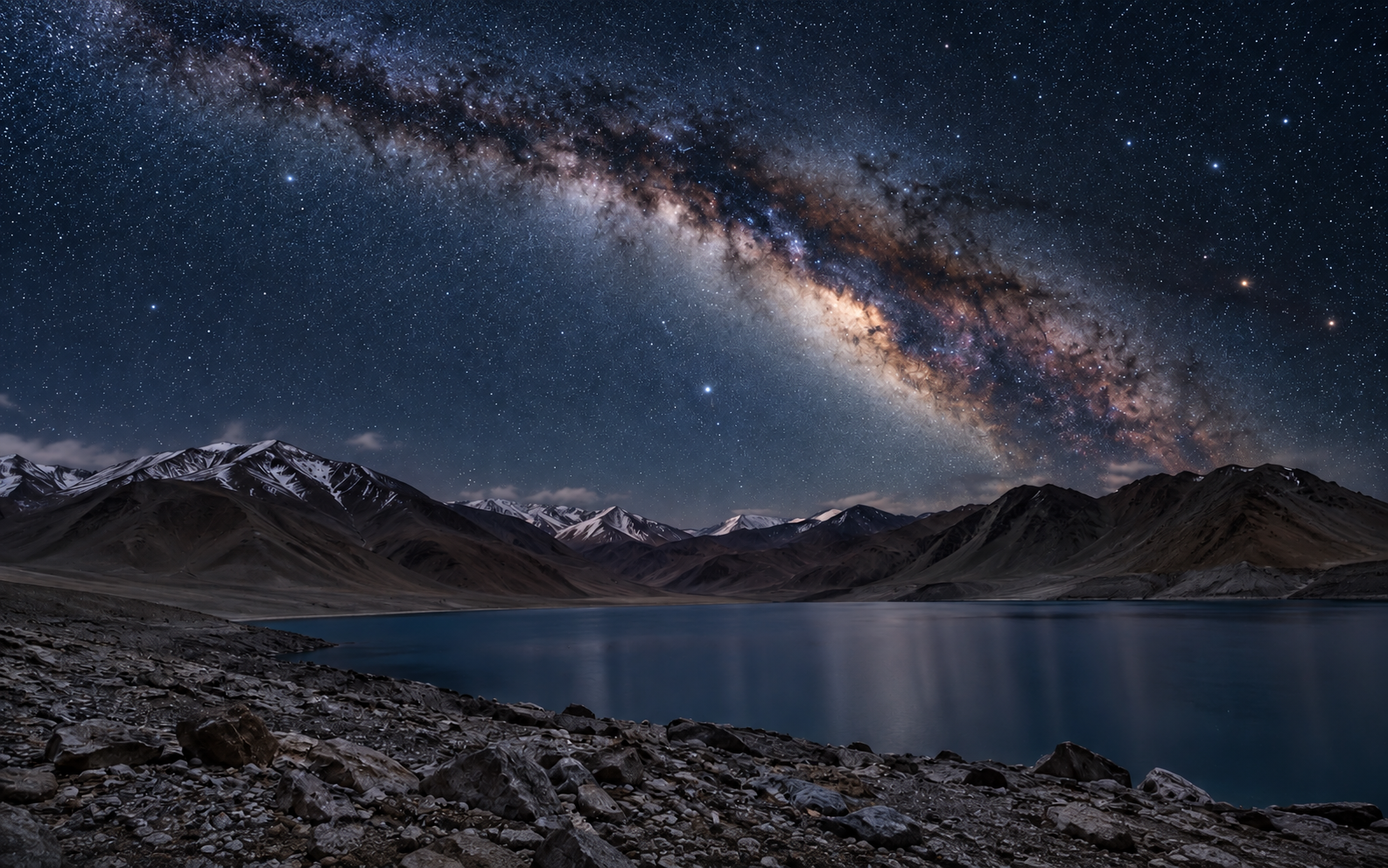
Stargazing in Ladakh: Where the Himalayas Meet a Sky Full of Stars
September 14, 2026
There’s a particular kind of quiet that settles over the northern reaches of Nubra Valley once the sun drops behind the Karakoram ridgeline. No traffic, no generators, no glow on the horizon from a town nearby. Just the sound of the Nubra River and, eventually, a sky so dense with stars that it takes a minute for your eyes to actually process what they’re seeing. If you’ve done the usual Ladakh stargazing spots and want something further off the map, the stretch running toward Sasoma, Warshi, and the Siachen corridor is where the real dark sky begins.
Why This Side of Nubra Is Different
Here’s the thing about Nubra Valley, most visitors never leave the main loop. Which sounds like a small detail, but for anyone chasing dark skies, it’s actually the whole point. The road heading north of Panamik barely sees any traffic, and there’s none of the light pollution that even a tiny settlement tends to bring with it.
A few reasons this stretch works so well:
- Altitude works in your favour. You’re starting off high already, above 3,000 metres, and it only gets higher as you push toward Sasoma and Warshi. Thinner air up there means the atmosphere scatters less light, so stars look crisper and the Milky Way stops being a vague smudge and starts looking like an actual band across the sky.
- There’s almost nothing between you and the sky. There’s also just not much around to get in the way. No towns, no streetlights, no hotel signs glowing somewhere off the road. This part of the valley is farmland mostly, quiet and largely untouched by tourism, which honestly is exactly why it works so well for this.
- The Karakoram gives you a picture-worthy horizon line. And then there’s the Karakoram range doing a lot of the visual heavy lifting. Peaks like Saser Kangri and Mamostong Kangri line up along the north, snow-covered even in the dark, giving you something real to look at instead of just flat land fading into nothing. Makes a difference whether you’re just standing there looking up or trying to get a decent photo.
The Old Silk Route Connection
This entire corridor once carried caravans of Bactrian camels moving pashmina wool, salt, and silk between Central Asia and the Indian plains. Sasoma and Warshi sat along that trade artery long before either name appeared on a tourist map, and the old route still runs more or less along the same line the road follows today.
Travelling this stretch at night, with the same peaks that traders once navigated by rising black against a field of stars, gives the experience a weight that a standard dark-sky viewpoint doesn’t have. You’re standing on a route that people have used to cross this exact landscape for centuries, which is part of why we think it deserves more attention than it currently gets.
Getting There: Panamik to Warshi
The road from Panamik continues north through a string of small villages before reaching Sasoma, which functions as the last major point before the terrain becomes more restricted and military-controlled. Warshi lies a short distance beyond Sasoma and currently marks the point up to which the regular Inner Line Permit allows civilian travel.
A few practical notes:
- You’ll need an Inner Line Permit, which is straightforward to arrange through a local operator or your accommodation in Nubra Valley.
- The road beyond Panamik is narrower and less maintained than the main Nubra circuit, so factor in extra driving time.
- Fuel and mobile networks get sparse the further north you go, so plan your day around that rather than assuming you’ll top up en route.
The Siachen Glacier Corridor
Beyond Warshi, the road leads on to the Siachen Glacier, the highest battlefield in the world, where Indian Army outposts have been established since the 1980s. Access to the Siachen Base Camp area has gradually opened up over the course of a decade. The district administration now permits visits to designated civil tourist facilities in the area of the base, with the generally only difference being an environmental fee rather than a military permit, which can and does vary depending on the security situation at the time.
This isn’t a stretch to attempt casually. Distances are long, altitudes are serious, and conditions depend on army clearance that can shift with little notice. What it does offer, for those who plan it properly, is one of the most dramatic settings in Ladakh for both daytime views and, if you’re camping partway, an extraordinary night sky at an elevation few tourists ever reach. Anyone considering the full push toward Siachen should coordinate with an experienced local operator who tracks current access rules, rather than relying on information from a season or two ago.
Best Spots for Stargazing
You don’t need to reach Siachen itself to get an exceptional sky. A few points along this route work well without pushing into restricted territory:
- Around Sasoma: Open, flat ground with a clear view north toward the glacier-fed peaks. Very little human light for kilometres in any direction.
- The approach to Warshi: The valley narrows here, which actually helps, since the surrounding ridgelines block any stray light and frame a tighter, more dramatic patch of sky directly overhead.
- The Nubra riverbank stretches away from the main road: If a late-night drive to Sasoma isn’t practical, even pulling off the main Nubra road once you’re clear of any settlement gives you a genuinely dark sky with the added benefit of running water in the background.
When to Go: The Night Sky Calendar
- March–May: Winter constellations fading out, Milky Way core starting to rise late night. Cold but generally clear.
- June–August: Best window for the Milky Way core, visible for most of the night. This is also when road access to Warshi and beyond is most reliable.
- September: Many long-time visitors consider this the best month overall. The summer heat has broken, the sky is at its clearest, and the route north is still fully open before winter closures begin.
- October onward: Access becomes weather-dependent, and temperatures drop fast. Only attempt this stretch with local guidance at this point in the year.
What to Pack
- A proper down jacket, not a fleece. Nights here drop well below what a summer evening in Leh would suggest.
- A red-light headlamp so you’re not ruining your own night vision every time you need to check something.
- Warm layers for your hands and feet specifically. This gets overlooked more than anything else.
- A tripod and spare batteries if you’re bringing a camera. Cold drains batteries fast at this altitude.
- Basic altitude sickness precautions if you’re pushing toward higher elevations near the glacier corridor.
Where to Stay
Doing this properly means basing yourself somewhere in Nubra Valley that isn’t itself flooded with tourist light, and that can actually help you plan the logistics rather than just handing you a map. Basing yourself close to the route toward Panamik and Sasoma also means an early start toward Warshi is genuinely feasible, without the long transfer times you’d face from Leh.
About Lchang Nang Retreat – The House of Trees
Lchang Nang is a destination created for travellers looking for peace and tranquility. Combining leisure and simplicity, it pays homage to its local heritage. The retreat is fully solar powered, and plastic containers are kept to a minimum, a small but real factor when your main reason for being here is the sky above it. In the coming years, Lchang Nang plans to grow and source most of its operational needs locally. It also maintains a vision for a sustainable future through eco-conscious initiatives.
The rooms themselves are built the old way, using mud, stone, and poplar timber, and that choice does more than look nice. It keeps things naturally warm once the desert cold sets in at night, which you’ll appreciate more than you’d expect after standing outside in the dark for a couple of hours waiting for the sky to do its thing. Breakfast isn’t rigid either, so if you’re heading out early for a dawn drive north, that’s not a problem. And if you’re thinking of pushing beyond Panamik, the travel desk can help sort out the itinerary and give you a sense of the route, which honestly makes the whole thing a lot less stressful to plan.
FAQs
Do I need a special permit to visit Sasoma or Warshi?
Yes, a standard Inner Line Permit is required, which covers travel up to Warshi. It’s easy to arrange through a registered operator or your accommodation in Nubra Valley, usually within a day, and doesn’t require the more complex documentation needed for areas closer to Siachen itself.
Can tourists actually visit Siachen Glacier Base Camp?
Civilian access to designated tourist facilities near the base camp has opened up in recent years, generally requiring an environmental fee rather than a military permit. Rules can change based on the security situation, so confirm current access with a local operator before planning around it.
What’s the best month for stargazing near Siachen and Nubra’s northern villages?
September is widely considered the best month. The summer heat has passed, skies are consistently clear, and the road toward Sasoma and Warshi is still fully accessible before winter closures set in around October.
Is this route safe to drive at night?
The road is narrow and unlit in stretches, so driving after dark isn’t advisable unless you know the terrain well. Most visitors head out before dawn or stay overnight partway, then position themselves for stargazing once they’ve reached a safe, parked spot.
How far is Sasoma from Lchang Nang Retreat in Nubra Valley?
From a base near Panamik, Sasoma is roughly 40 kilometers further north, which typically takes 90 minutes to two hours given the road conditions. It’s a manageable day trip if you leave with enough daylight to spare for the return drive.