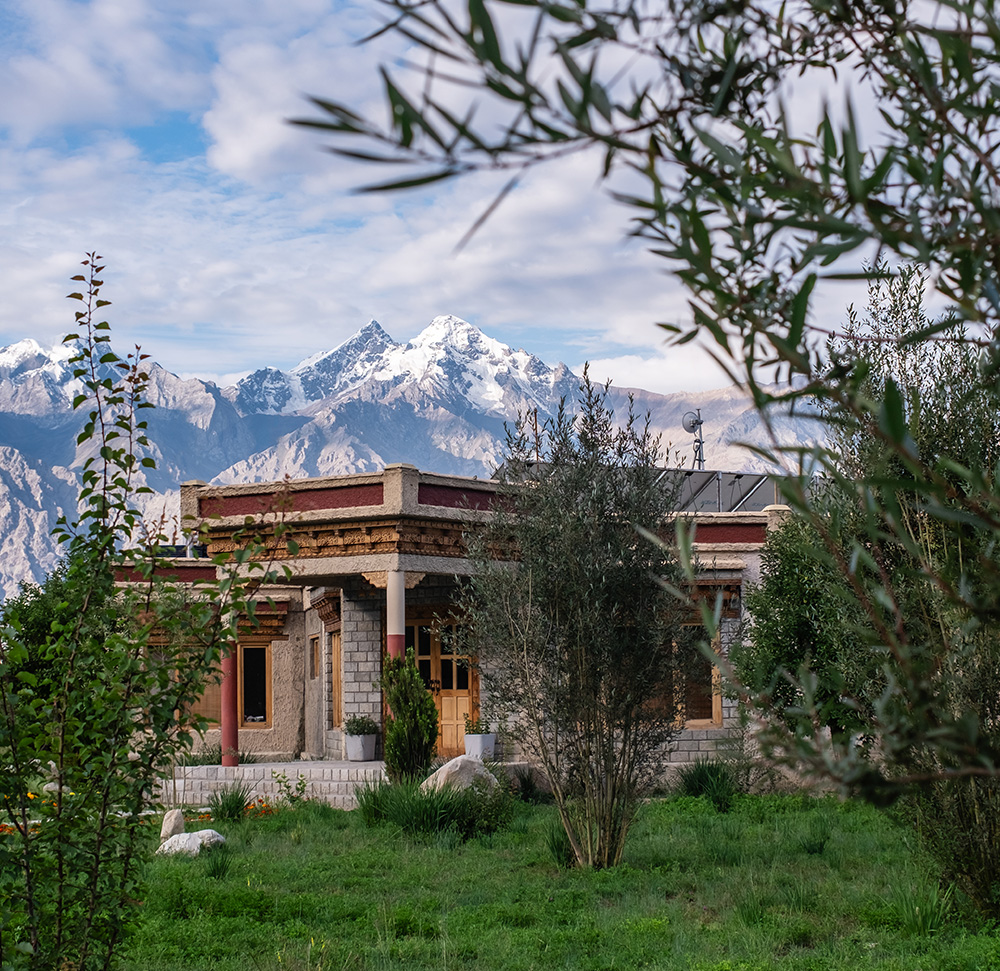
Stay Amid Apricot Blossoms: A Unique Spring Experience in Ladakh
April 14, 2026
There is a version of Ladakh that the internet doesn’t show often enough.
Not the turquoise lakes in August. Not the jeep convoys on Khardung La. Not the prayer flags catching a summer wind. This version arrives quietly, in late March, when the desert valley floor turns white and pink overnight and the Karakoram stands snow-heavy behind it all, unbothered and enormous.
Apricot blossom in Nubra Valley is the Ladakh secret that the summer tourist misses entirely, and the traveler who times their trip around it comes back describing it as the best thing they’ve seen in the mountains. Not the most dramatic. The most beautiful. There’s a difference.
The Blossom Window: Brief, Unmistakable, Worth Everything
The apricot trees bloom before the leaves arrive. Bare branches, then flowers. White and pale pink against the brown of the mountains, the gravel of the river bed, the flat grey of the high-altitude sky on a cold March morning. Then, for a few days in the middle of the window, the valley does something that no summer photograph from the same location replicates, it holds the blossoms at peak, every tree full, the Karakoram white behind them, the air carrying a faint sweetness that catches you off guard at 3,000 metres. It feels less like a landscape and more like a decision the valley made, to be briefly, completely beautiful, before the petals loosen and the leaves take over.
It lasts two to three weeks. Sometimes less if the wind comes early or the temperature drops sharply after a warm spell. The traveler who plans specifically for this window, arrives during the first week of April, stays ten days, leaves when the petals begin to fall, experiences the valley at a moment of improbable beauty that the summer visitor simply doesn’t see.
The Apricot Festival, held annually during this blossom period, marks the season formally,local celebrations, cultural programmes, the valley’s agricultural communities acknowledging the moment the orchards return to life. For a traveler already there for the blossoms, the festival adds a layer the landscape alone doesn’t provide.
The footfall is a fraction of peak season. Diskit Monastery in early April is a monastery. In August it’s a tourist site. Hunder’s sand dunes with the blossomed trees visible in the middle distance and the Karakoram above that, this particular combination of desert, orchard, and high peak exists only in this window, at this altitude, in this specific valley.
Nubra Valley in Spring: The Valley Returns to Life
Nubra Valley in spring is the agricultural season beginning after the long Ladakhi winter. The orchard work resuming. The irrigation channels opening. The specific sounds of a community returning to its outdoor rhythms after months of cold and snow.
The Shyok and Nubra rivers are still cold, carrying snowmelt from passes that haven’t fully thawed. The nights are sharp. The mornings take longer to warm up than they will in summer. And none of that matters when the orchard outside the window is flowering and the mountain behind it is white and the air has the particular quality of high-altitude spring, cold and clean and carrying something that smells faintly of blossom.
The sand dunes at Hunder remain extraordinary. The Bactrian camels are still there, double-humped and prehistoric-looking. The Diskit Monastery still sits above the valley doing what it has done for centuries. Panamik’s hot springs remain therapeutic. But everything in Nubra Valley in spring is framed by the flowering, and the flowering changes the register of the entire landscape.
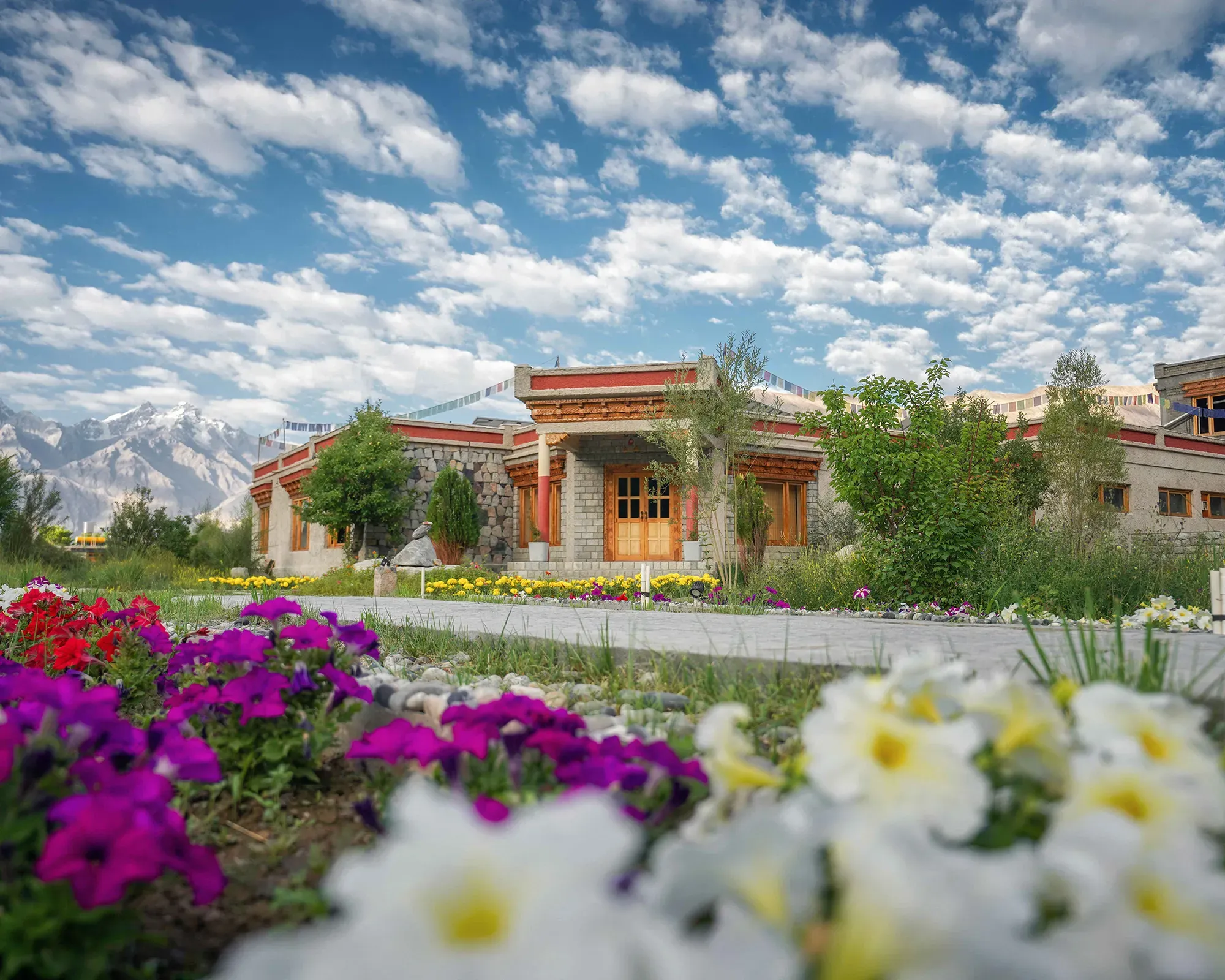
After Dark, The Nubra Sky
Mention should be made of the nights.
The spring sky above Nubra Valley, with no monsoon moisture in the atmosphere and the tourist season not yet arrived to add light pollution from generators and headlights, is one of the better stargazing skies in India. The Milky Way is visible clearly. Constellations sharp enough to understand why ancient civilisations built cosmologies around them. The temperature drops fast after sunset, the cold that makes the blanket necessary and the sky more impressive for requiring the effort to go outside and look at it.
This is the Ladakh that people describe afterward in the way that’s difficult to make sound reasonable to someone who hasn’t been, the flowers during the day and the stars at night and the silence that exists at this altitude in this season when the summer crowd hasn’t arrived yet.
Lchang Nang Retreat, Inside the Orchards
Located in the Tegar Village. Nubra riverbank. The orchard surrounding the property rather than visible from a distance.
Lchang Nang Retreat — The House of Trees, is the specific answer to how a traveller stays inside the apricot blossoms rather than visiting them. 17 individual cottages built in traditional Ladakhi style, mud, stone, poplar timber, each with a private garden sit-out that faces the orchards directly. In blossom season, the flowers are not down the road. They are outside the sit-out door.
- The retreat has built a dedicated Apricot Blossom 7-day itinerary for this specific window. Guided orchard walks through the flowering trees with someone who knows the agricultural and cultural significance of each variety,
- Village walks through Tegar,
- The Old House Museum for the Nubra heritage story,
- The Farm Table dining using the valley’s seasonal produce,
- BBQ and stargazing at the sand dunes after dark.
The evening programme that turns the sky into the second extraordinary thing about the day.
The wellness programme at Lchang Nang reflects the setting rather than importing something generic. Sunset yoga at the sand dunes. Yoga at the holy lake. Mindfulness sessions with a monk from nearby Samstanling Monastery. Chakra harmonisation at Stonba. The spa treatments are rooted in Ayurvedic tradition and designed for the Himalayan environment specifically.
The property is owned by the Kalon family of Nubra, built on family grazing land on the riverbanks. This is not an outside hospitality operation managing a beautiful location at arm’s length. It’s a family’s valley, made accessible to guests who want to understand it rather than simply pass through it.
- Solar-powered,
- Traditional building materials,
- Glacial meltwater,
- No single-use plastics.
The regenerative philosophy is operational rather than decorative, visible in how the property runs daily rather than stated in the brochure and forgotten by checkout.
Featured in National Geographic, Condé Nast Traveler India, Architectural Digest India, and Nikkei Asia. Six Senses partner. The recognition reflects the standard consistently maintained rather than a single impressive moment.